Disclosure: Shhots AI is our product. Shhots AI runs Seedance 2.5, Kling 3.0 and Veo 3.1 for product ads, so we have a stake in the model comparison. The tool table is compiled from each vendor's documentation, read in October 2026, not from a side-by-side test with one script.
An AI microdrama is a short, serialised fiction video, usually 1 to 3 minutes an episode in 9:16, made partly or entirely with generative AI instead of a cast and crew. The models that make it possible in October 2026 are Seedance 2.5 (30 seconds a pass, 30 reference images), Kling 3.0 (15 seconds, multi-shot, native dialogue) and Veo 3.1 (8 seconds, 3 reference images, scene extension). One good clip is easy. Keeping the same face, coat and voice across twenty episodes is the hard part, and the workflow does more for it than the model does. This guide covers the market behind the format, the tools, an 8-step pilot workflow, what it costs, where to publish, and seven brand ads running on Meta in October 2026 that already use the form.
What is an AI microdrama?
An AI microdrama is a microdrama whose actors, sets, dialogue or camera work were generated by AI. The format itself is older than the tools: microdramas are vertical, serialised stories with a hook, a conflict and a cliffhanger per episode, built for phones and sold through short-drama apps.
| Feature | Typical format |
|---|---|
| Episode length | 1 to 3 minutes, sometimes under a minute |
| Aspect ratio | 9:16 vertical |
| Structure | Serialised, 10 to 80 connected episodes |
| Genres | Romance, revenge, thriller, fantasy, horror, mystery |
| Beats per episode | Hook in 5 seconds, conflict, twist, cliffhanger |
| Characters | A recurring lead and two or three supporting roles |
| Distribution | Short-drama apps, TikTok, Reels, Shorts |
| Production | Live action, AI, or a hybrid of both |
A single AI-generated short film is a short film. A microdrama is serialised: it holds an audience across episodes, which is also where AI production gets hard.
How is an AI microdrama different from a traditional one?
Traditional production films real actors on real sets and fixes the rest in post. AI production replaces some or all of that with generated characters, environments, dialogue and camera moves, from text-to-video or image-to-video models. Hybrid production shoots real footage and uses AI for extensions, backgrounds or dubbing. None of the three approaches makes a story good. AI lowers the cost of a scene, and the script and a recognisable cast still decide whether anyone watches episode two.
Why are AI microdramas growing in 2026?
Because the audience for short drama arrived first, and the models caught up this year.
Sensor Tower’s State of Short Drama Apps 2026 report, published June 2026, counts more than 850 million short-drama app downloads worldwide in Q1 2026, up 140% on a year earlier, and roughly $750 million in in-app purchase revenue for the quarter, up 20%. DramaBox and ReelShort each took close to $140 million of that. Average time in these apps reached 25 minutes a day globally by April 2026. Those numbers cover the whole category, mostly live-action shows. They are not AI microdrama revenue. They are the audience AI microdramas are competing for.
China shows what cheap AI production does, and does not do
Reuters reported on 24 September 2026 that 221,900 new AI shows launched on Douyin in the first half of 2026, citing DataEye. Only 1,055 of them passed 100 million views, the usual benchmark for a hit. The same report puts the cost of an AI short drama at a few hundred yuan a minute, down from about 5,000 yuan ($747) a minute, and lists city subsidies for AI filmmakers in Shanghai, Beijing, Shenzhen and Hainan.
Read both halves of that. Production got roughly ten times cheaper, and about one show in 200 found a large audience. Cheap video does not make a story popular.
The same rush produced the first likeness dispute. In April 2026 a Chinese model and a stylist told AFP that their faces, taken from social media photos, had been cast without consent in The Peach Blossom Hairpin, an AI series on ByteDance’s Hongguo app. Hongguo removed the show. If you build characters from photos of real people, that is the outcome to expect.
US platforms are testing the format, mostly without AI video
Peacock announced original microdramas in June 2026, starting with Campus Confidential, an unscripted Bravo series, plus scripted vertical titles. The AI in that announcement is a tool that converts horizontal video to vertical and an AI-guided Andy Cohen experience. The shows themselves are filmed.
Character.AI’s (c.ai) Series, described in its August 2026 post, is three vertical series (Last Summer, The Nighttime Game, Eden Fall) made by a human-led studio team with AI in the workflow, where over-18 viewers can chat with the characters after an episode. The company says creator tools for making your own series will follow.
So in October 2026 the fully AI-generated microdrama is a Chinese phenomenon at scale and an independent-creator experiment everywhere else. That is the opening.
How are AI microdramas made?
With a pipeline of separate stages rather than one prompt. A working one runs:
Premise, then screenplay, then character references, then storyboard, then one generation per shot, then voices and sound, then an edit, then the next episode from the same assets.
Each stage fixes a different failure. A language model writes a screenplay but has no idea what the lead looks like. A video model renders a confrontation but has no memory of episode four. The workflow is what connects them.
The problem that decides everything: continuity
Say your lead is a 29-year-old woman with short black hair, a small scar above her eyebrow and a dark green coat. Episode one is right. In episode two her jaw is wider. By episode five the model has cast someone else. Costumes, apartments, props and voices drift the same way.
Every model in the table below has a reference feature for this, and all of them still need an approved reference pack and a series bible attached to every generation. Creators who finish a season keep both files current. Creators who post one clip and stop usually skipped them.
Which AI tools are best for microdramas?
There is no single AI microdrama generator worth the name yet. Some tools make a whole short story from a premise with little control. Others give shot-level control and leave assembly to you. The table is compiled from each vendor’s documentation, read in October 2026, not from a controlled test.
| Tool | Best for | What it documents | What it leaves to you |
|---|---|---|---|
| Seedance 2.5 | Long narrative shots | 30 seconds a pass, multi-round extension, up to 30 images, 10 video and 10 audio references, audio with video | Episode planning and quality control |
| Kling 3.0 | Dialogue scenes | 3 to 15 seconds, native audio, multi-shot in one generation, element lock for a consistent lead, dialogue in 5 languages | Season-level consistency and the edit |
| Google Veo 3.1 | Cinematic realism | Native audio, up to 3 reference images, first and last frame, scene extension, 9:16 | Clips of up to 8 seconds, so more shots per episode |
| Runway Gen-4 References | Character and location stills | Up to 3 reference images to hold a character, object or place across images | Story, video generation and assembly |
| StoryShort | A whole short story from one idea | Writes the story, makes characters, scenes and voices, exports 30 seconds to 3 minutes | Shot-level control; pricing not stated on the page we read |
| Open-AI-Micro-Drama-Generator | Developers | MIT-licensed 8-stage pipeline, Claude Sonnet 4.6 and FLUX.1 via MuAPI, Kling v2.1 for 5-second clips, MoviePy assembly | Setup, API credits, upgrades to current models |
| ElevenLabs | Voices and dubbing | Fixed voice per character, multilingual dubbing | Lip sync on the video side |
| CapCut, DaVinci Resolve | The edit | Timing, captions, sound, assembly | Everything before the edit |
Seedance 2.5 for longer scenes
ByteDance announced Seedance 2.5 on 31 July 2026 with up to 30 seconds a generation, multiple rounds of extension, references of up to 30 images, 10 video clips and 10 audio clips in one pass, audio generated with the video, and timestamp-level editing. For a microdrama that means one generation can take the lead’s portrait, the apartment, the supporting actor and a style frame together. It does not plan a season for you. Shhots AI runs it for 30-second product ads, so that is the use we know it from.
Kling 3.0 for dialogue and multi-shot scenes
Kuaishou’s Kling 3.0 guide documents 3 to 15 seconds a clip, native audio with multi-character dialogue, automatic or custom multi-shot so one generation can cut from a wide shot to a reaction close-up, an element lock that holds the lead through camera moves, and dialogue in Chinese, English, Japanese, Korean and Spanish. For two people arguing in a kitchen, that is the shortest path to a usable scene. Review every line of dialogue; accents and timing still miss. Kling 3.0 is also the default UGC model on Shhots AI.
Google Veo 3.1 for cinematic shots
Veo 3.1 adds up to three reference images for characters and objects, first-frame and last-frame control, scene extension that continues from the last frame of the previous clip, native dialogue and sound effects, and 9:16 output. Clips run up to 8 seconds, so an episode is more shots and more joins. For an abandoned hospital corridor the same character walks down in every episode, Veo’s references and extension hold the look well. Shhots AI runs Veo 3 and Veo 3.1 for product video.
Runway Gen-4 References for the reference pack itself
Runway’s Gen-4 References takes up to three reference images and generates the same character, object or location in new settings, lighting and angles. Use it to build the still reference pack: the lead in a neutral portrait, then the same person in the office, the restaurant and the apartment. Those stills then feed whichever video model you generate with.
StoryShort for a first experiment
StoryShort writes the story, creates characters with a held appearance, generates each scene, adds voices, music and captions, and exports 30 seconds to 3 minutes, longer on higher plans. Signing up is free and generation uses credits from a paid plan; the page we read in October 2026 did not state prices. It is the fastest way to see what a story looks like before you build a pipeline, and the least control once you want to fix one shot.
Open-AI-Micro-Drama-Generator for developers
Open-AI-Micro-Drama-Generator is an MIT-licensed open-source pipeline, about 530 stars in October 2026, that runs story development, character extraction, scene scripts, portraits, storyboards of 3 to 5 shots a scene, first frames, 5-second video clips and concatenation as separate agent stages. It uses Claude Sonnet 4.6 and FLUX.1 through MuAPI, Kling v2.1 for video and MoviePy for assembly, on FastAPI and Next.js. Treat it as a reference architecture: the video model is two generations old and it has no season memory. What it shows well is that an AI microdrama generator is an orchestration layer around several models, with the video model as one stage.
How do you make your first AI microdrama?
The example below is a fictional thriller called The Last Message: a 60-second pilot, two characters, one apartment, and an ending that makes you want episode two.
Step 1: Write a premise with a question in it
Premise: a woman receives a voice message from her own phone number. The voice warns her not to answer the door. Seconds later, someone knocks.
That works because it asks three questions at once: who sent it, why, and who is outside. Before you write anything else, answer four things. Who is the protagonist? What do they want? What interrupts them? What question carries viewers into episode two? For a first series keep it to two characters and one location. Romance, revenge and thrillers are the proven genres on short-drama apps, but an original premise beats a popular genre.
Step 2: Draft the screenplay with an AI writer
ChatGPT or Claude will write a usable first draft if you ask for structure instead of a summary. A prompt that works:
Act as a writer of vertical microdramas. Create a four-episode psychological thriller titled “The Last Message”. Each episode runs about 60 seconds, uses no more than three speaking characters, and takes place mainly inside one apartment. Open every episode with an event or question in the first five seconds. Include visual action, concise dialogue, escalating conflict and a cliffhanger. Keep continuity across the series. First write a synopsis, character profiles and episode outlines, then the full screenplay for episode one. For each scene give duration, location, characters, dialogue, visual action and narrative purpose.
Then edit by hand. AI drafts over-explain, repeat lines and add twists that do not follow from earlier scenes. Read it on a phone. If a line needs a second read, cut it.
Step 3: Build a series bible
Keep one document that every prompt and every reference image points back to. For The Last Message:
- Series: The Last Message. Psychological thriller. Four vertical episodes of about 60 seconds.
- Lead: Maya, 28, an architect who moved into a new apartment two weeks ago.
- Supporting: Daniel, her neighbour, who knows more about the messages than he says.
- Location: a modern apartment, warm lamps, wooden floor, one large window on the left of the living room, a dark hallway to the door.
- Look: photorealistic, restrained performances, slow camera, low-key light.
- Open question: why do the messages come from Maya’s own future?
After each episode, add what it established: wardrobe, props, who knows what, and which questions are still open. This is the file that stops episode three from contradicting episode one.
Step 4: Make reference images for each character and location
For every recurring character generate a front portrait, a profile and a full-body image in their main outfit, with the same hair, face, accessories and marks. Write the description once and reuse it:
Maya, 28, shoulder-length dark brown hair, narrow face, brown eyes, a small silver necklace, beige cardigan over a black top, dark trousers. Photorealistic, natural skin texture, soft practical light.
Approve one set and save it. The rule that matters: reuse the approved files, never regenerate the actor. Do the same for the apartment. If the window is on the left in episode one, it stays on the left.
Step 5: Storyboard the episode shot by shot
| Time | Beat | Shot |
|---|---|---|
| 0 to 7s | The warning | Maya sees a message from her own number |
| 7 to 15s | The recording | She plays it and hears her own voice |
| 15 to 23s | The reaction | Close-up as she listens |
| 23 to 32s | The knock | A knock cuts the silence |
| 32 to 42s | The hallway | She walks to the door |
| 42 to 52s | The peephole | She sees Daniel outside |
| 52 to 60s | Cliffhanger | Her phone plays a new message: “That’s not Daniel.” |
The times are edit targets. A shot may take two clips and a trim to land. With the board in hand you generate seven specific shots, each with its own prompt and references, and the episode is assembled from the keepers.
Step 6: Generate each shot with reference images attached
For dialogue, start with Kling 3.0 or Seedance 2.5. For the establishing shot of the hallway, test Veo 3.1. Attach the character and location references wherever the model accepts them. A prompt for shot three:
Cinematic close-up of Maya, matching the attached reference, in her softly lit apartment at night. She holds a phone in her right hand. Her expression moves from confusion to fear as she listens to a voice message. The camera pushes in slowly. Natural facial motion, subtle breathing, warm interior light, dark background. 9:16. Keep Maya’s face and clothing identical to the reference. No other characters.
One controllable moment per generation. Generate alternate takes and keep the best performance. Split anything complex into two shots rather than writing a longer prompt.
Step 7: Add voices, sound and captions
A good-looking scene with a flat robotic line still reads as fake. Use the model’s native audio, or generate dialogue with ElevenLabs using one fixed voice per character, defined in the bible (Maya: soft American English, medium pitch, breathy when frightened; Daniel: low, controlled, reserved). Check lip sync on every dialogue shot, because a separate voice track does not move the mouth. Then build the room: quiet ambience, the notification, the knock, footsteps on wood, a low musical rise. Never clone a real person’s voice without written permission.
Step 8: Edit, check continuity, export and reuse the assets
Assemble the shots in CapCut or DaVinci Resolve in storyboard order. Cut long pauses and repeated movements. Watch it once with sound and once without; the pictures should carry the story on their own. Keep captions legible on a phone and off the faces, and leave room for the platform’s interface. Last frame: “That’s not Daniel.” Cut to black.
Before export, check faces, hair, costume and voice against the bible, check that no line contradicts an earlier scene, and look at hands, reflections and objects, which models still get wrong. Export in the platform’s ratio and resolution. Then file the script, references, approved clips and bible together. Episode two starts from those files, which is where AI production finally gets cheaper than starting over.
Can AI agents produce a microdrama series?
The manual workflow teaches you the craft. Around episode ten it becomes the bottleneck, because every episode repeats the same eight jobs by hand. An agent system splits those jobs into stages: a story agent, a continuity agent that tracks what each episode established, a character agent that holds the reference pack, a storyboard agent, a video agent that picks the model per shot, an audio agent, an editing agent and a quality agent that flags drift. The open-source project above is a simplified version. A production system would need season memory, reusable assets, retries, cost tracking and a human approval step before credits are spent. You still make every creative call. You spend fewer hours moving files between tools.
How much does an AI microdrama cost to make?
It depends on the model, the length you generate, retries and how much of the audio and edit you do by hand. The number to track is generated seconds, not finished seconds.
A 60-second episode built from 12 five-second shots needs 12 usable clips. At 2.5 attempts per keeper, you generate about 30 clips. For a dated price anchor: on Higgsfield’s pricing page, read 13 October 2026, a Seedance 2.5 video costs about 15 credits and Pro is $43 for 900 credits, so roughly $0.72 a generation, clip length not stated. Thirty generations is about $22 of video for the pilot, before images, voices and your time. Our Higgsfield pricing post has the full credit table.
| Line | Example |
|---|---|
| Finished episode | 60 seconds |
| Usable shots | 12 |
| Attempts per usable shot | 2.5 |
| Clips generated | 30 |
| Cost per generation (Higgsfield Pro, Seedance 2.5, Oct 2026) | about $0.72 |
| Video generation for the pilot | about $22 |
Reuters’ September 2026 figure for Chinese studios, a few hundred yuan a minute down from 5,000 yuan ($747), is the industrial version of the same arithmetic. To keep your own number down: approve references and a storyboard before you generate, test the hardest scene first, reuse the apartment and the costumes, and count attempts per keeper rather than comparing subscription prices.
How do you write an AI microdrama that people finish?
- Start with the problem. “Maya gets a warning from herself” opens an episode. “Maya moved in two weeks ago” is backstory, and it can wait.
- Change something every episode. A secret, a reversal, a loss. If the character ends where they started, the series stalls.
- Earn the cliffhanger. A message, a confession, an interrupted sentence. The best ones make the viewer reread an earlier scene.
- Keep a shape. Hook, conflict, escalation, revelation, cliffhanger. Sixty seconds is enough for all five.
- Write people as well as twists. Give the lead a want and a flaw. A series built only on shocks gets predictable by episode four.
Which genres work best for AI microdramas?
| Genre | Why it suits AI | The production risk |
|---|---|---|
| Mystery | Questions and reveals make natural episode hooks | Plot continuity across episodes |
| Psychological thriller | Tension from two people in one room | Believable facial performance |
| Romance | The format’s biggest audience | Natural dialogue and chemistry |
| Revenge | Clear motive, escalating conflict | Repetitive beats |
| Fantasy | Worlds and creatures that cost nothing to build | Visual consistency |
| Horror | Atmosphere works in short form | Physical contact and pacing |
| Science fiction | Environments the camera could never afford | Action and world consistency |
Start with mystery or thriller. Two characters, one apartment, no crowds, no fights.
Where can you publish an AI microdrama?
TikTok, Reels and Shorts are the starting point for an independent creator: post episodes in order, number them, keep one recognisable cover frame, use playlists where the platform has them, and read the comments as your writers’ room. Test a concept here before you commit to a season.
Short-drama apps such as ReelShort, DramaBox, FreeReels, NetShort and ShortMax hold the paying audience. Each has its own submission terms and AI-content policy, and some only take shows from partner studios, so read those pages before you plan a season around one.
Your own site makes sense once viewers come back on their own. You control the player, the episode order and the analytics. You also have to bring every viewer there yourself, which is the part social platforms were doing for you.
How do AI microdrama creators make money?
Six routes exist in October 2026: ad revenue on platforms whose programs accept the content, sponsorships written into the story, paid episodes or subscriptions where a platform supports them, licensing characters or finished series to a distributor, series made to order for brands, and interactive experiences around the characters, which is Character.AI’s model. The rights and revenue-share terms differ for each, so read them before you pick.
On YouTube, two policies apply. Realistic AI-generated or altered content must be disclosed at upload, and since 15 July 2025 the Partner Program’s inauthentic-content rules exclude mass-produced, repetitive videos from monetisation. An original serialised story with its own characters sits on the right side of that rule. A template run 200 times with a new product name each time sits on the wrong side.
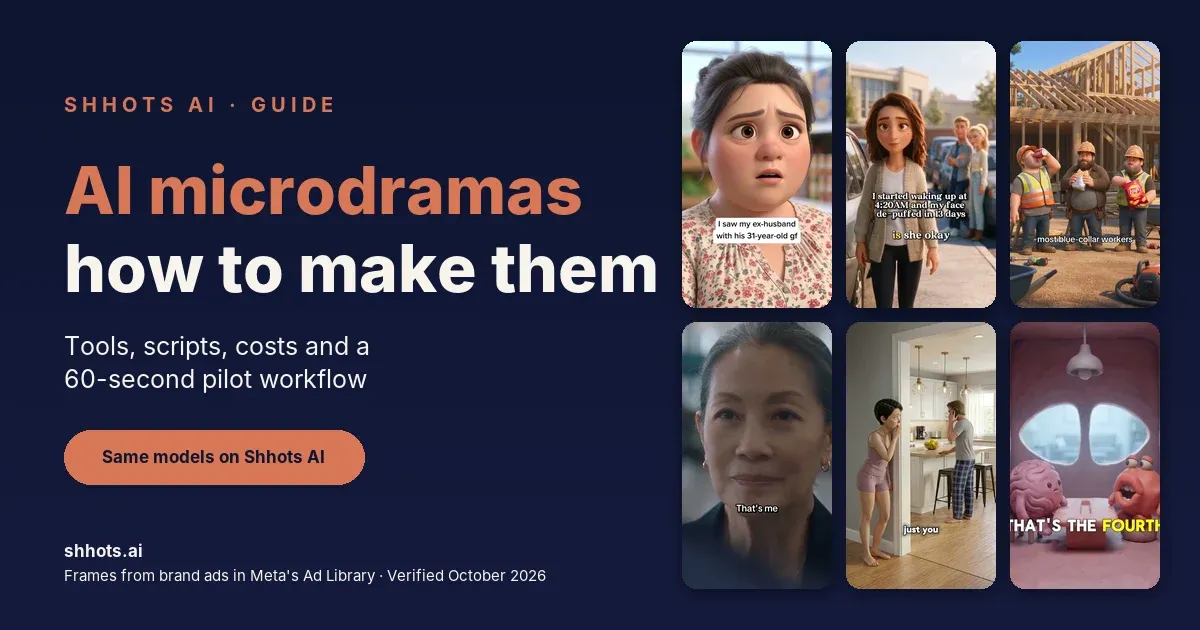
What do AI microdrama ads look like today?
The clearest working examples in October 2026 are paid ads on Meta. The seven below come from Meta’s Ad Library, where they were running that month. Each is a single-episode drama in 9:16, 1 to 5 minutes long, told in the first person, with the product arriving as the turn in the story rather than the opening line. Six are 3D animated in the style the Pixar comparisons keep reaching for; the Koriderm spot is live-action in look. All of them are AI-generated or AI-assisted as far as we can tell, and we have not verified each brand’s pipeline. The clips are 10-second muted excerpts, credited to the brand, so you can see the opening hook. Each one is a complete story, so the full ads are worth watching in the Ad Library.
| Brand | Product | Style | Length | Opening line |
|---|---|---|---|---|
| BioRoot Labs | Gut supplement | 3D animated | 3:36 | ”I saw my ex-husband with his 31-year-old gf” |
| Ankhway | Mushroom gummies | 3D animated | 4:52 | ”I had to stand next to my ex husband and the woman he left me for” |
| Rise Science | Sleep app | 3D animated | 3:03 | ”I started waking up at 4:20AM and my face de-puffed in 13 days” |
| Tradesman Nutrition | Shred sachets | 3D animated | 1:25 | ”Most blue-collar workers are shocked how fast this drops the gut” |
| Cosmetic Times | Face cream | 3D animated | 1:42 | A husband on the phone: “I told you I’m gonna tell her it’s over” |
| Koriderm | Time Reverse Cream | Live-action look | 1:00 | A border officer: “Ma’am, this passport photo doesn’t look like you” |
| Speech Blubs | Speech app for kids | Claymation | 1:06 | ”Come on buddy, say mommy” |
Five things repeat across all seven:
- A first-person line in the first second. Every one opens on a confession or an accusation. “I saw my ex-husband” is the whole hook, and the product shot waits.
- A humiliation scene before the discovery. The supermarket, the garden party, the gossiping couple, the passport desk. The product is the answer to a scene the viewer has already felt.
- One recurring lead, held for minutes. These run 1 to 5 minutes with the same face, hair and outfit throughout. That is the continuity problem from earlier, solved at ad length.
- Animation as a choice, not a shortcut. Six of seven are animated. Animated faces survive AI generation better than photoreal ones, and the style signals story rather than testimonial.
- A claim at the end, not the start. Guarantees, bundles and “two tubes for $79” arrive after the story, which is the opposite of a direct-response ad.
Serialisation is the one thing missing. Each of the seven is a self-contained episode. Bring the same character back next week with a new problem and you have a brand microdrama, and at that point the reference pack and the bible above carry more weight than the choice of model.
Can brands use AI microdramas as ads?
Yes, and the seven ads above are the proof: single-episode stories that run as paid media. A skincare brand can write a four-episode romantic comedy in which two people keep meeting at the wrong moment and the product sits in the scene. A fashion label can build a mystery around one accessory. Branded microdramas trade the direct-response structure of a product ad for attention and recall, so measure them on returning viewers and assisted conversions, not views.
Shhots AI makes product ads, and it runs the same three models: a 10, 15 or 30-second AI video ad from a product photo on Seedance 2.5, Kling 3.0 or Veo 3.1, with a commercial license, from $19 a month. A 30-second UGC ad uses 1,651 credits of the 2,000 on Starter, so a serialised campaign of 30-second episodes is a Pro or Scale job. The 3D animated video style is the closest thing to a recurring character the app makes today.
Microdrama production is on the roadmap for Shhots Agent, and it is not in the app today. The Agent is the planning layer that reads a brand, proposes a bounded content plan and makes the approved outputs in one chat, and a series is the kind of multi-step job it is built for. It is on a waitlist and ships on the Scale plan first. We will announce microdrama capabilities separately, with what they cost, when they exist.
What mistakes sink AI microdramas?
- Generating each episode from scratch. Faces and rooms drift. Keep the bible and the reference pack.
- One giant prompt. Models fail on multi-character, multi-location scripts. One moment per generation.
- Treating audio as a finishing touch. A robotic line undoes a good shot. Plan voices with the characters.
- Too much story for the tools. Crowds, fights and stunts multiply retries. Two people, one room, first.
- Judging by views. Track completion, return rate and follows. A viral episode one with no episode two audience is a clip, not a series.
- Skipping rights. Original characters, licensed music, written consent for any real face or voice, and the AI policy of every model and platform you use. The Peach Blossom Hairpin was pulled for exactly this.
AI microdramas FAQ
What is an AI microdrama?
An AI microdrama is a short serialised fiction video, usually 1 to 3 minutes an episode in vertical 9:16, with recurring characters and a cliffhanger per episode, made partly or entirely with generative AI for the actors, sets, dialogue or camera work.
How long is an AI microdrama episode?
Most run 1 to 3 minutes, and many creators start under a minute. Short-drama apps serialise stories into dozens of episodes of that length. Pick the length your story and platform need.
What is the best AI microdrama generator?
There is no single tool that makes a whole series well in October 2026. StoryShort makes a complete short story from one idea with little control. Seedance 2.5, Kling 3.0 and Veo 3.1 give shot-level control with reference images, and you assemble the episode yourself. Pick by how much control you want over each shot.
How do you keep AI characters consistent across episodes?
Approve one reference pack per character (front, profile, full body) and one per location, write a fixed description, attach them to every generation, and review each clip for changes in face, hair and clothing before it goes in the edit. Seedance 2.5 takes up to 30 reference images, Veo 3.1 and Runway Gen-4 References take 3, and Kling 3.0 locks elements in frame.
Can I make AI microdramas for free?
Only the first experiment. Daily free credits on Seedance through Dreamina, or on Hailuo, are enough to test a premise, usually with a watermark or a cap of a few clips a day; our free image-to-video tools post lists the current tiers. A season costs money for generations, retries, voices and editing, and several free tiers exclude commercial use, so read the terms before you publish.
Are Peacock’s microdramas AI-generated?
No. Peacock’s microdramas, announced June 2026, are filmed scripted and unscripted series, starting with Campus Confidential from Bravo. The AI in Peacock’s announcement does two other jobs: it converts horizontal video to vertical, and it guides viewers through Bravo clips.
What are Character.AI’s microdramas?
Character.AI’s (c.ai) Series, described in its August 2026 post, are three vertical series (Last Summer, The Nighttime Game, Eden Fall) made by a human-led studio team using AI in the workflow. Viewers over 18 can chat with the characters after an episode. Creator tools for making your own series are planned.
What are Chinese AI microdramas?
Short AI-generated dramas made for Douyin, Hongguo and other Chinese platforms. Reuters counted 221,900 AI shows launched on Douyin in the first half of 2026, of which 1,055 passed 100 million views, with production at a few hundred yuan a minute and city subsidies for AI filmmakers.
Can I monetize AI microdramas on YouTube?
Yes, if the series meets the Partner Program’s rules. Realistic AI content must be disclosed at upload, and since 15 July 2025 mass-produced, repetitive videos are excluded from monetisation. An original story with distinct episodes qualifies; a template run hundreds of times does not. Earnings are never guaranteed.
Does Shhots AI make AI microdramas?
Not yet. Shhots AI makes 10 to 30-second product ads on Seedance 2.5, Kling 3.0 and Veo 3.1, from $19 a month. Microdrama production is planned for Shhots Agent, which is on a waitlist and ships on the Scale plan first. We will publish the capabilities and prices when they exist.
Sources
- Sensor Tower, State of Short Drama Apps 2026, June 2026
- Reuters, China fuels rush to turn AI video into an industry, 24 September 2026
- AFP via TechXplore, AI drama accused of stealing faces, April 2026
- NBCUniversal, Peacock deepens mobile engagement with vertical video and original microdramas, June 2026
- Character.AI, (c.ai) Series, August 2026
- ByteDance Seed, Introducing Seedance 2.5, 31 July 2026
- Kling AI, Video 3.0 user guide
- Google DeepMind, Veo
- Runway Academy, Gen-4 References
- Open-AI-Micro-Drama-Generator on GitHub
- YouTube Help, Disclosing use of altered or synthetic content